Episode 99: Respect My Authority

Synopsis

What exactly is authority? Where does it come from? How do you get it? Can you move authority from St. Paul, MN to the south side of Chicago? Join Em and Jesse for a wide-ranging chat on the subject.

Notes

1/ Of course, many people in addition to women have a hard time getting others (i.e. non-group members) to pay attention to their authority. For example, trans and nonbinary people have a hard time getting anyone to listen to them speaking about their own lived experiences.

2/ I’ve published four novels and a novella since this was recorded, and people actually do think I’m an authority on some topics for some reason.

3/ The story about Aristotle’s phony translators comes from here, I think: https://historyofphilosophy.net/translation-movement

Pseudopigrapha: from pseudo, false, and epigraphe, name or inscription. A falsely attributed text.

U of Michigan’s Galileo text: “After an internal investigation of the findings of Nick Wilding, professor of history at Georgia State University, the library has concluded that its “Galileo manuscript” is in fact a 20th-century forgery. We’re grateful to Professor Wilding for sharing his findings, and are now working to reconsider the manuscript’s role in our collection.” Also, “Wilding concluded that our Galileo manuscript is a 20th-century fake executed by the well-known forger Tobia Nicotra.” (The quotes are from the linked website.)

4/ According to the Virginia Woolf society, the actual quote is: “I would venture to guess that Anon, who wrote so many poems without signing them, was often a woman.” (From ch 3 of A Room of One’s Own.)

Pseudo-Dionysius the Areopagite (5th/6th century CE))

Pseudo-Pseduo-Dionysius is anyone once thought to be Pseudo-Dionysius but now recognized (by modern scholars) to be someone other than Pseudo-Dionysius. Confused?

5/ Pseudo-Bonaventure (14th century CE) wrote Meditations on the Life of Christ.

6/ I’ve become a bit more familiar with copyright law in the three years(!) since we recorded this, since I’ve published three going on four books of my own since then. A really good example of a point I think past Em is trying to make is Sherlock Holmes, who has recently passed into public domain. He’s a neat character and everyone wanted to play with him (look at the adaptations of recent memory: the Robert Downey Jr. films, the BBC’s Sherlock, the American Elementary). But because of copyright law, this was fairly difficult and confusing until very recently, despite the character’s creator having been dead since 1930. These cases raise many questions of authorship vs ownership and how long someone should really be able to make money on an idea. (Patent Law is, if anything, worse, from what I understand.)

7/ It was a photograph of Prince! Since we recorded this, the Supreme Court sided against Andy Warhol’s estate: https://www.npr.org/2023/05/18/1176881182/supreme-court-sides-against-andy-warhol-foundation-in-copyright-infringement-cas

Girl Talk is awesome: https://www.youtube.com/watch?v=kSoTN8suQ1o

I mention him because there was a really good documentary about copyright called RiP! A Remix Manifesto that discussed his work (including a discussion of it with the head of the copyright office of the Library of Congress).

8/ Just to clarify, “fair use” is kind of a complicated issue. When you are a non-commercial educational podcast (ahem), you can use things (like samples of YouTube performances) without having to pay licensing fees. You can also fairly quote sections of things for criticism, news reporting, and research. You can therefore quote lines from songs or poems in textbooks, but not in novels because they aren’t considered teaching. Parody (hello, Weird Al!) can be a weird gray area, because a parody obviously has to be somewhat transformative but still retain enough of a likeness that people will know what you’re parodying, and on this question hangs a lot of lawsuits. (Not toward Weird Al though, as far as I know. But Margaret Mitchell’s estate did try to sue to block the publication of The Wind Done Gone.)

See also: Why does Ulysses (in Em’s novels) wear so many band T-shirts and occasionally mention songs and artists, but there are zero song lyrics in the books? Because you can’t copyright band names or album/song titles.

Steamboat Willie has actually entered public domain since we recorded this! [So amazing!–Jesse]

Peter Pan actually first appeared in 1902!

Also, sorry, “Peter Pan is a psychopomp” is somehow not a sentence I had on my bingo card. I guess it has lost a bit in its translation to the screen… On the plus side, SIDS rates have dropped dramatically since 1902?

“I can rewrite Macbeth if I want to.” Or a really complex riff on The Bacchae? Em of 2022 did not know what was coming, lol.

9/ Notably, Spivak also quotes primarily women.

The episode on Hrotsvit: Episode 22

10/ For more on Juliana of Cornillion and the Feast of Corpus Christi, see Episode 6.

11/ Wife of Bath’s Prologue and Tale are HERE. (Also, Chaucer was not, as far as we know, toxic like Joss Whedon!)

12/ Incidentally, violent, in-the-moment reactions to mistreatment by another person are called reactive abuse, and they’re often used by abusers to shift the blame onto their victims. If you are being abused or wondering if you are and want to talk to someone, check out the National Domestic Violence Hotline (https://www.thehotline.org/), or look for local programs. Here in Madison, for instance, we have Domestic Abuse Intervention Services (https://abuseintervention.org/).

Episode 17: Dance Like Nobody’s Watching

Synopsis

Dance dramas are theatrical presentations that use dance (and sometimes words, but mostly dance) to tell a story. Em and Jesse look at dance dramas from around the world, from Mesoamerica before and after the Spanish invasion to Japan. With a number of digressions involving Prince, Irish step dancing, Alvin Ailey, and the movie Being John Malkovich.

Annotations and Corrections

1/ A shout out to Manual Cinema in Chicago. Here’s the Candyman trailer.

We talked about Kara Walker in episode 10 (see notes 16 and 24).

2/ The theatre in the Water Tower is Lookingglass Theatre. Mr and Mrs Pennyworth (trailer here) was a Lookingglass Theatre production with Manual Cinema. If you’re in Chicago, we recommend them both.

The Chicago International Puppet Theater Festival is here. They’re doing workshops at the end of October/through November 2020 online, and more will undoubtedly pop up. Check them out.

Also, check out the Center for Puppetry Arts in Atlanta–great programming for kids.

3/ Dance drama! We talked about this a little bit at the end of episode 12 (note 30), in the context of Aztec and Mayan dance dramas.

Misty Copeland is the first African American woman to become a principal dancer for American Ballet Theatre, which is one of the biggest ballet companies in the US (if you are like me/Em and don’t understand what a principal dancer is–it’s like having a fifth degree black belt in dance, I guess). For his own purple reasons, Prince hired her to dance on top of his piano (and throughout his stage show) back when he was still alive and touring. [Heart.–Jesse]

Race in ballet is a complicated topic, but it is worth noting that until relatively recently, it was common for non-White ballerinas to powder their skin while performing to appear paler, while some roles were danced by White dancers wearing blackface. In addition, there are traditional standards for what ballerinas look like that privilege the look of white bodies. Finally, ballet is expensive to train in if you’re not being paid–think $200 per month for pointe shoes.

The Richmond, VA woman who took up Irish dance is Morgan Bullock and video of her can be found here.

Ballerinas changing the Lee statue in Richmond (and much more!): Brown Ballerinas for Change.

Alvin Ailey founded his own dance troupe and choreographed a landmark piece called “Revelations.” More about “Revelations” here.

An excerpt from Dada Masilo’s Swan Lake. NYT write-up.

2/ Sor Juana Inez de la Cruz (1648–1695). Wrote the Loa for the (Auto Sacramental of the) Divine Narcissus. See episode 12, note 30 and following.

Of women elsewhere in Europe doing amazing things during this time, look no farther than Sophia of the Palatinate (1630–1714), who became electress of Hanover and was mother of (the British) King George I. Had seven children who lived to adulthood and had Gottfried Leibniz as her librarian and personal friend before dying age 83. Her descendants now occupy all seven European thrones and Luxembourg.

Anne (1665–1714) was also queen of England during this period (beginning 1702).

3/ Nahuatl is an interesting language. Here are some words in it you already know or might recognize: chipotle, coyotl, axolotl, chocolotl. [English likes to import food words. Lots of other words too, English is a very spongy language, but definitely food words.–Jesse]

The Chester play was discussed in episode 8 (see note 26).

The Spanish-style morality play discussed here is a last judgment play (titled Final Judgment) in Nahuatl. An English translation can be found in Stages of Conflict edited by Taylor and Townsend. Sor Juana de la Cruz’s Loa and the Mayan Rabinal Achi can also be found in translation in this excellent collection.

A slightly fuller explanation of the sexism of the Final Judgment: The priest stops our heroine, Lucia, from confessing(!!!) and accuses her of not accepting the seventh sacrament, holy matrimony. Presumably the point isn’t just that she’d been sleeping around but that she may have been married in an Aztec ceremony, which of course wouldn’t count. I refrained from mentioning in the podcast that Christ himself appears (it’s the Last Judgment, remember) and berates Lucia, helping to thrust her into Hell(!!!!). Again, the play is horrifically sexist and excruciatingly colonialist, but it’s a fascinating study.

“You have to be allowed to confess everything, that’s the point.” See also Michel Foucault’s History of Human Sexuality, vol. 1 on the link/transfer between confession to priests and confession to analysts in modern society. [Oooooo, yes!–Jesse]

[24:21] “They have a God…” They actually have a couple of gods–Quetzalcoatl, and the one I am struggling to name, Coatlicue (“Snake Skirt”). (“Coatl” means snake in Nahuatl; -tl or -tli are absolutive singular suffixes for non-possessed nouns, I hope Dou are glad I looked that up.)

Jesse: Interestingly, Coatlicue is a mother goddess, so it’s possible that an indigenous audience would have seen Lucia actually turned into Coatlicue after (as a reward for?) the horrors Christ and the Spanish attempt to visit on her. Probably not the ending the Spanish intended.

I’d also like to give a shout out here to contemporary lesbian, Chicana, playwright Cherrie Moraga. Check out The Hungry Woman: A Mexican Medea and Heart of the Earth: A Popol Vuh Story to get started.

4/ The Mayan dance drama Rabinal Achi was also discussed in episode 12 (see note 30).

5/ On the ritualistic language of courtrooms:

(Thanks to this site)

But also there are specific things that people DO in courtrooms and ways that they act (the swearing in, the way the judge and jury are addressed, the times of standing and sitting) are incredibly ritualistic.

6/ This discussion is about Christ’s trial scenes in the York Cycle plays. Henry IV had the Archbishop of York, Richard Scrope, convicted of treason and executed. However, it took two judges to do the job (the first judge refused). In the York Cycle, Pilate is unwilling to condemn Christ in his first trial before Pilate, but in the second trial before Pilate, Pilate is more than happy to condemn Christ. Pamela King has demonstrated that these two scenes from the York Cycle clearly represent the real events of the Archbishop’s trials and consequently draw a connection between Pilate and the government of Henry IV. See Pamela King The York Mystery Cycle and the Worship of the City (Cambridge: D.S. Brewer, 2006); pgs. 189–200. Amazon link.

Over the course of Shakespeare’s 2 Henry IV Act IV, we see the Archbishop of York (Richard Scrope) arrested for treason and summarily executed.

Links to the York Cycle, The First Trial before Pilate, and The Second Trial before Pilate.

The Revello Passion Play or La Passione di Revello. Sacra rappresentazione quattrocentesca di ignoto piemontese edited by Anna Cornagliotti (Amazon Italy link. If you read Italian, check out WorldCat!

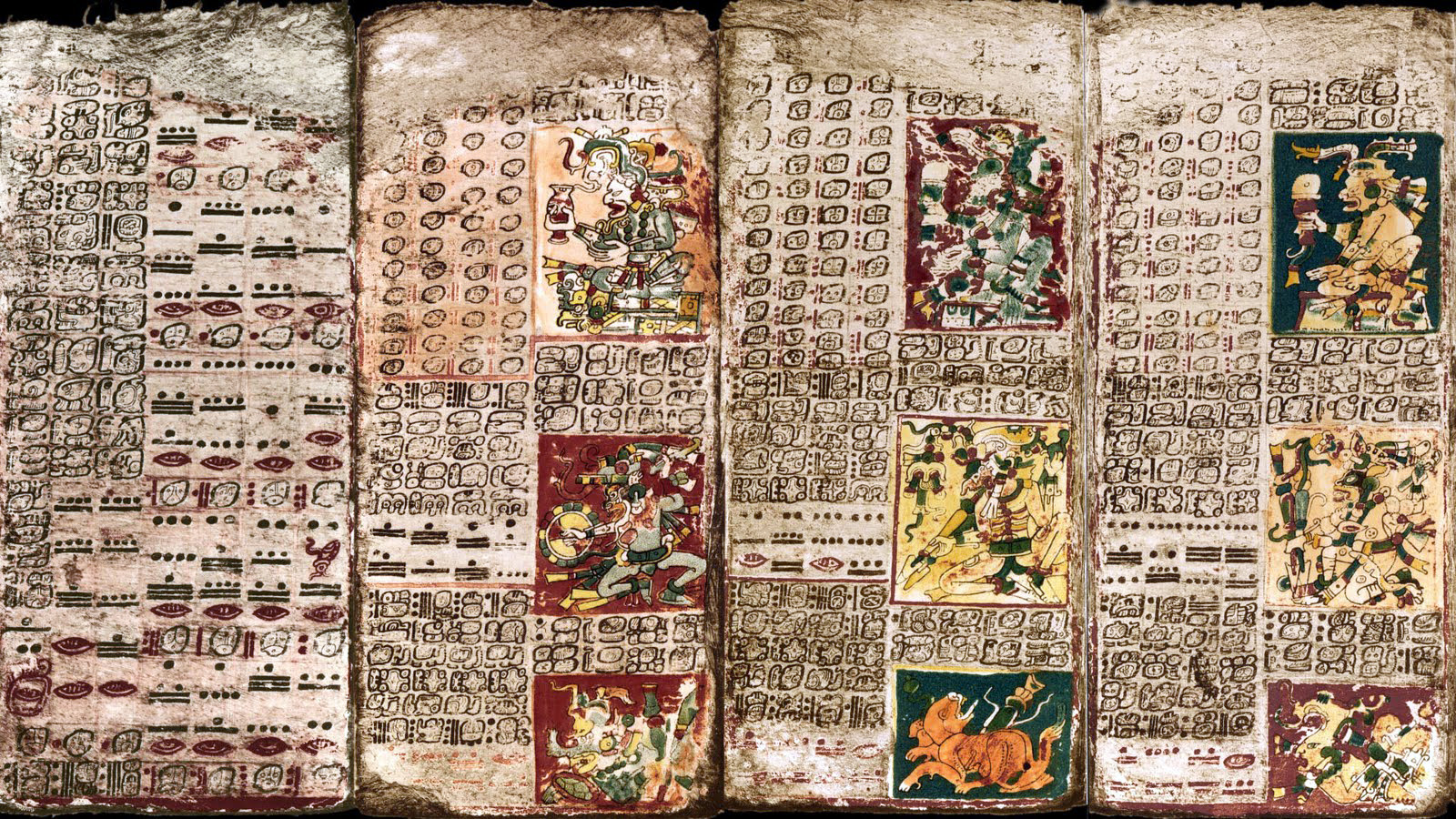
The Mayan warrior at the far left in the middle has a shield and a raised club/battle axe. (This is an image from the Dresden Codex.) For more codices, see this site.

Here’s a statue of a Mayan warrior with a shield (presumably the club or axe is missing from the open hand).

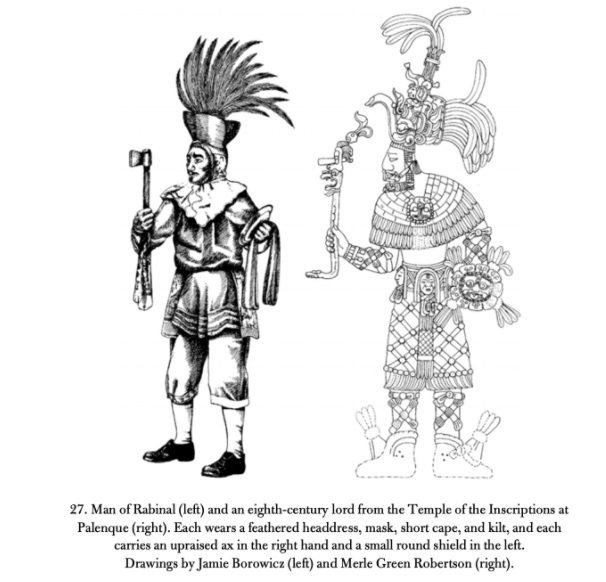
From Dennis Tedlock’s Rabinal Achi: A Mayan Drama of War and Sacrifice, p. 131.

Just for fun, a Mayan statue of a young corn god (Mayan and Aztec culture definitely intermingled!).

Mayan sacrifice by decapitation (Close up on the axe, middle/left.)

The intersex servant is referred to as a slave but clearly has a fairly important ceremonial position.

The change of number in the warriors’ names from 13 Yellow (or Golden) Eagles and 13 Yellow (or Golden) Jaguars to 12 happened before the script was written down in the extant version. Nonetheless, the symbolism of the numbers makes it fairly clear that this is a change–one that was apparently made quite early, presumably as part of the process of adapting Rabinal Achi slightly in order to be allowed to continue performing it under the Spanish. (Of the many other dance dramas that existed, this is the only one we still have.) This is a change that would have aligned nicely with the new performance date of St Paul’s Day and other similar syncretic adaptations.

7/ Atsumori. And here’s a full performance. Watch times if you don’t have time to watch the whole performance: entrance of waki/priest 6:00–8:00; entrance of shite/Atsumori disguised as a common grass cutter 18:35–20:20; entrance of kyogen/townsperson 41:20–42:00; entrance of Atsumori as ghost-warrior self 1:00:00–1:01:40; Atsumori dances out his death 1:18:20–1:21:20 and 1:26:00–end (notice the use of the sword).

Zeami Motokiyo wrote it and a lot of other stuff.

8/ [1:07:35] Em should have said “Chinese-speaking people” rather than “Chinese people.” We regret the error.

9/ Beyoncé (feat. Kendrick Lamar). Still super iconic.

Jesse: I purposely ignored black/brown/yellow/redface in my comments on “full face makeup,” because while racist makeup is an extremely important thing to discuss, it should NOT be used as an excuse to explain why the so-called West seems to have given up on full face makeup and/or masks. These issues are partially related, but also separate.

10/ Being John Malkovich. Still one of the most surreal films I [Em] has ever seen, I think.

Basil Twist and Stickman–a marionette performance that will make you cry.